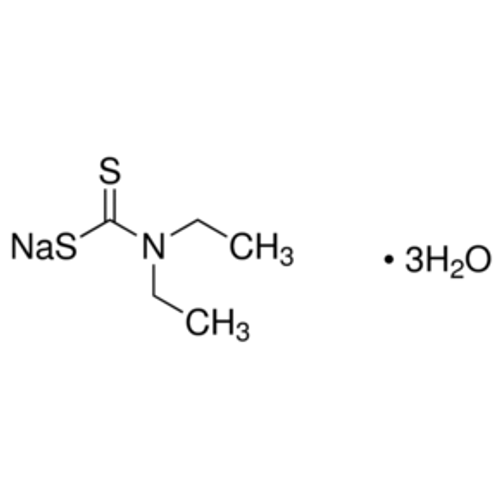
Sodium Diethyldithiocarbamate Trihydrate ACS Reagent, 500 grams
You are from United States (US), price will be in United States (US) dollar ($).
United States dollar ($) - USD
$389.71
Sodium Diethyldithiocarbamate Trihydrat ACS Reagent 500 Gram
Synonym: Cupral, Diethyldithiocarbamic acid sodium salt
- CAS Number 20624-25-3
- Linear Formula (C2H5)2NCSSNa · 3H2O
- Molecular Weight 225.31
- Beilstein/REAXYS Number 3920507
- EC Number 205-710-6
- MDL number MFCD00150617
- PubChem Substance ID 24853702
- NACRES NA.21
| Grade | ACS reagent |
| Vapor Density | 5.9 (vs air) |
| InChI Key | WWGXHTXOZKVJDN-UHFFFAOYSA-M |
| composition | Na (as Na2SO4), 30.5-32.5% |
| mp | 95-98.5°C (lit.) |
General description
Sodium diethyldithiocarbamate trihydrate may be used:
To synthesize cis-dichlorobis(N,N-diethyldithiocarbamato) tin(IV) by reacting with tin(II) chloride.
As an alternative to xanthates to generate carbamoyl radical precursors.
To synthesize a soluble precursor polymer for poly(thienylene vinylene).
To synthesize dichlorotetrakis(dimethyl sulfoxide)ruthenium (II), which can be a precursor to prepare other ruthenium complexes.
Application
Spin trap used in conjunction with Fe2+ to detect NO in brain, kidney, liver, and other tissues. Simultaneous direct measurement of NO* and pO2 has been reported. A copper chelator, it has been used to quantitate copper in biological materials by ESR and is an inhibitor of superoxide dismutase, ascorbate oxidase, and other enzymes.
Spin trap used in conjunction with Fe2+ to detect NO in brain, kidney, liver, and other tissues.
Safety Information
Signal word Warning
Hazard statements H302-H400
Precautionary statements P301 + P312 + P330
Personal Protective Equipment dust mask type N95 (US), Eyeshields, Gloves
RIDADR UN 3077 9 / PGIII
WGK Germany 3
RTECS EZ6550000